

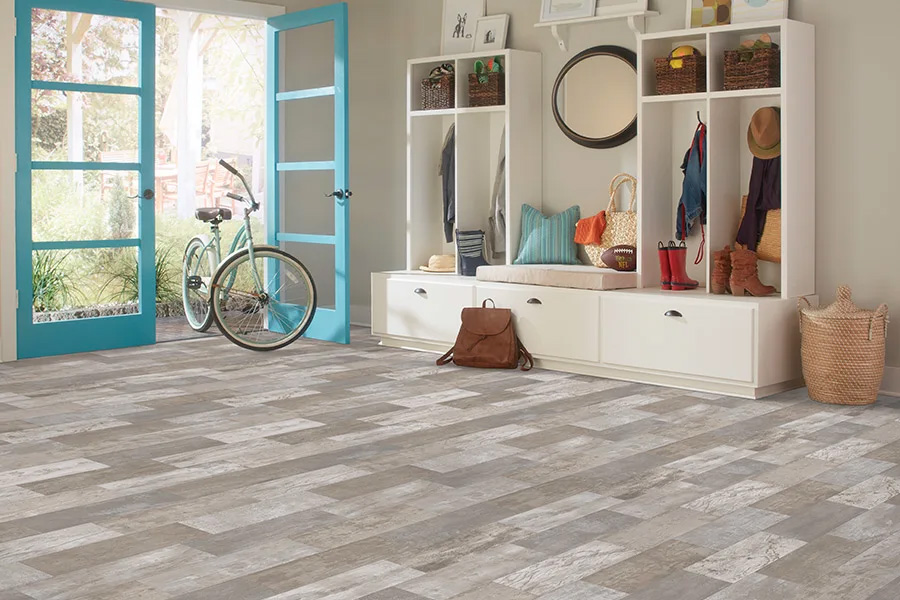
Atlanta asks more of a floor than almost any housing market in the country — and unlike harsher climates, it asks politely, persistently, season after season, year after year: nearly fifty inches of rain in a normal year, summer humidity that turns crawl spaces into greenhouses, an April pollen event visible from space, and the red clay that rides into every Alpharetta and Roswell entryway from February to November. Floors here rarely fail dramatically; they get patiently and methodically worn down, season by season and year by year, by a humid subtropical climate that never once takes a week off.
Waterproof luxury vinyl plank — LVP — is the category engineered for exactly this assignment, and it has quietly become the answer our team reaches for across more North Fulton rooms than any other hard surface. This guide goes considerably deeper than the brochure: what is actually under your house and why that decides the spec, how LVP handles each of Georgia’s three signature messes, what the click-lock joint really does for a floor, and how to read a product label with the practiced eye of our showroom staff. Start browsing the waterproof luxury vinyl collection alongside — nearly sixty lines deep as of this writing — and the luxury vinyl overview for the category basics.
First Question: What Is Under Your Floor?
Metro Atlanta is unusual — we build on everything. North Fulton neighborhoods mix full basements (often finished, often the best square footage in the house), vintage crawl spaces under ranches and split-levels, and slab-on-grade construction in newer sections. Each foundation moves moisture toward your flooring differently, and each changes what “waterproof” needs to mean for you. Tap through the cutaways:
Below grade, moisture arrives two ways: slow vapor breathing up through concrete, and the occasional storm-week scare. Rigid-core waterproof LVP is the hard-surface default here — the planks themselves cannot swell — but the slab still gets a moisture evaluation before installation, because trapped vapor is a building question, not a plank question. Atlanta’s love affair with finished basements is exactly why this category exploded locally.
The crawl space is Atlanta’s humidity amplifier: shaded, damp, and breathing summer moisture up at the subfloor from below. LVP’s dimensional stability is a genuine advantage over moisture-shy materials here, and the pre-install check focuses on subfloor condition and flatness — the things our estimators actually crawl around verifying before quoting.
Slab homes are the simplest case: test the slab, level where needed, and float or glue the floor per product spec. The Atlanta wrinkle is the door line — slab homes sit close to grade, so storm-week track-in lands directly on the main living floor. Waterproof plank plus a serious walk-off mat is the working answer.
The Georgia Grime Lab: Pollen, Red Clay, and Storm Week
National flooring articles test products against generic “spills.” Atlanta floors face a more specific opponent calendar: the yellow-green pollen film of late March, red clay that stains soft materials on contact, and the soaked-shoe parade of a summer thunderstorm week. Run each one across a waterproof plank floor, then wipe:
Choose a mess above. The panel is a waterproof LVP floor; the buttons are a Georgia calendar.
What the “Click” Actually Does
Most waterproof LVP installs as a floating floor: planks lock to each other — not to the subfloor — through a milled tongue-and-groove profile that snaps home at an angle. That joint is doing three jobs at once: holding the field tight as one continuous raft, keeping seams closed against surface water, and allowing the floor to expand and contract as a unit through Atlanta’s humid summers and furnace-dried winters. Click the demo together:
Apart: each plank arrives milled with this interlocking profile. Installation is geometry — set the angle, lower, lock. It is also why a damaged plank can be addressed by a pro without demolishing the room.
Read the Label Like Our Staff: Tap to Decode
Two waterproof planks can sit side by side at the same price and live very different lives in your hallway. The differences are printed right on the spec sheet — if you know which five lines to read. Tap each line of this composite label:
WATERPROOF LUXURY VINYL PLANK
Tap any Decode button to translate the jargon.
Humidity, the Long Game
Storm water is dramatic, but Atlanta’s deeper flooring test is atmospheric: months of saturated summer air, then a furnace-dried January, then back again — year after year. Organic materials respond to that cycle the way wood always has, expanding and contracting with the seasons; it is manageable with the right products and installation, but it is real, and it is why our area’s flooring conversations so often orbit moisture behavior. Rigid-core LVP’s superpower is boring in the best way: dimensional indifference. The core neither swells in August nor shrinks in January, seams stay tight through the cycle, and the floating floor moves as one calm raft within its expansion gap rather than board by board.
That stability also simplifies the whole-house question. Where mixed materials meet — plank hall, wood living room, tile bath — each material’s seasonal personality shows at the seams. The fewer temperamental transitions, the quieter the house ages. It is one reason continuous waterproof plank across a main level has become such a North Fulton default: one material, one behavior, zero seasonal drama from the front door to the back slider.
Pets, Kids, and the Second Floor
The households that ask about LVP here are rarely hypothetical: it is the family with the golden retriever and the lake towels, the toddler with the sippy cup vendetta, the bonus room above the garage that hosts every sleepover in Johns Creek. Two specs do the family-proofing. The wear layer from the decoder above handles claws and grit — buy the 20-mil class for the rooms where the action is. The attached pad handles the second floor: upstairs plank without acoustic padding telegraphs every footstep to the ceiling below, while cushioned-back product keeps the bonus-room stampede tolerable. Add texture-rich, low-sheen visuals — which hide micro-scuffs and pet hair between cleanings — and the floor effectively disappears from the household worry list.
The honest exception remains bedrooms: many families still prefer carpet softness where bare feet start the day, and our carpet collection plus LVP halls is a combination we install constantly. There is no purity prize in flooring — only rooms done right.
Stairs, Trim, and the Details That Read “Finished”
A plank floor’s field installs quickly; its reputation is earned at the edges. Stairs deserve special mention because floating floors do not float down steps — stair applications use their own components and fastening, planned as their own line item. Transitions where plank meets tile, carpet, or exterior doors want the correct profile at the correct height, chosen at measure time. Trim — quarter round or wall base — conceals the expansion gap a floating floor requires, and color-matched options exist for most quality lines. None of these details is exotic; all of them are the difference between an installed floor and an assembled one, and they are precisely what a professional quote includes that a square-footage guess does not.
What the Professional Install Actually Buys
Click-lock marketing has convinced a generation that LVP installs itself, so here is what our installers actually do that a long weekend does not. They flatten: checking the slab or subfloor against the product’s tolerance and correcting dips that would flex joints later. They acclimate when products call for it and stage materials properly. They plan the layout — plank direction toward the main light, seams staggered handsomely, no slivers at thresholds. They cut around the awkward truths of real houses: stair noses, vents, cased openings, the fireplace hearth. And they leave behind transitions and trim that fit, plus a floor whose manufacturer warranty terms were respected from the first row. The product makes that work possible; the workmanship makes it permanent.
Room by Room: Where Waterproof Plank Earns Its Atlanta Keep
The finished basement is the headline act — the rec rooms, home gyms, and guest suites below grade that make North Fulton houses live larger than their listings. Kitchens follow: wood looks with dishwasher-leak immunity, comfortable for long cooking nights. Entries and mudrooms take the storm-and-clay beating with the 20-mil wear layers from the decoder above. Laundry rooms and baths trade tile’s chill for warmer footing without surrendering water safety. And increasingly, whole main levels run one continuous waterproof floor front door to back slider — a look that suits open Alpharetta and Johns Creek plans and eliminates every transition strip along the way.
Where we counsel something else: bedrooms that want plush warmth (that is carpet territory), formal spaces where real wood’s resale gravity matters (see our hardwood guide and our piece on engineered vs. solid hardwood for Johns Creek homes), and bathrooms where tile remains the design statement — a mixed-material plan is normal here, and coordinating it is what our design consultations do.
The Real-Wood Question, Answered Honestly
Every LVP conversation eventually reaches it: but is it as good as real hardwood? The honest answer is that they are different purchases. Genuine wood keeps the resale gravity, the underfoot authenticity, and the refinish-someday future — our hardwood guide and our deep dive on engineered vs. solid for Johns Creek homes cover that side properly. Waterproof plank keeps the peace: zero water anxiety, zero humidity drama, claw-and-chaos tolerance, friendlier budgets. The pattern we see in North Fulton is not either-or but both-where-each-belongs — wood in the front-of-house living spaces where its warmth and equity show, waterproof plank in the basements, baths, mudrooms, and kid zones where its invincibility matters. A design consultation coordinates the tones so the whole house reads as one decision.
Where the Budget Actually Goes
LVP quotes diverge less on plank price than on everything around it — useful to know when comparing bids. The product tiers track the specs from the decoder: wear layer, core class, attached pad. The installation side carries subfloor preparation (the flatness work the click-lock depends on), transitions and trim, stair components where they apply, and removal and disposal of whatever the new floor replaces. A quote that skips prep is not cheaper — it is incomplete, and the floor will collect the unpaid balance in clicks and gaps later. Our estimates itemize so the comparison is honest, and financing can spread a whole-level project into manageable payments, subject to credit approval.
Buying It Right in North Fulton
The path that works: shortlist styles in the luxury vinyl catalog (filter waterproof, then by look), order free samples and audition them in your home’s actual light — Atlanta tree canopy makes rooms darker than showrooms — then book the free in-home estimate, where rooms get measured and the foundation cutaway from this article gets evaluated for real. Installation follows with the subfloor prep the click-lock demands, by installers who do this daily for both homes and businesses. Knowledgeable staff, next-day appointments, financing available: the buying experience is built to be the easy part.
Waterproof LVP Questions from Around North Fulton
Is waterproof LVP really safe for a finished basement in Atlanta?
LVP or laminate — what is the honest difference?
Will dark planks show our famous pollen?
How fast does an LVP project move?
Can you do the kitchen remodel at the same time?
Does LVP work over my existing floor?
Where can I stand on these floors before deciding?
Built for the Climate You Actually Live In
A closing word on timing, because Atlanta’s calendar offers genuine strategy here. The smartest months to plan an LVP project are the calm ones — late summer into fall, after storm season’s worst and before holiday hosting — when schedules are flexible and the new floor gets a gentle break-in before its first pollen April. But the honest fine print is that waterproof plank is the one category with no wrong season: no acclimation drama, no humidity windows, no cure times holding rooms hostage. If the basement carpet finally lost its last argument with the dehumidifier in February, February works fine. The estimate is free whenever you are ready, and next-day appointments mean ready can be tomorrow.
Floors in metro Atlanta do not get judged on showroom days — they get judged in pollen week, after the third thunderstorm in a row, on the morning the retriever finds the one puddle in the yard. Waterproof luxury vinyl is the category that treats those days as routine — the floor that turns the climate from an adversary into background noise. Check our reviews, browse the waterproof collection, order the free samples, run them through your own version of the Grime Lab at home, and let us match the spec to your foundation, your rooms, and your particular flavor of Georgia chaos. The estimate is free, the appointments can be next-day, and the floor will be ready for whatever April sends.
Pollen-proof, storm-proof, basement-proof — and beautiful anyway. Let’s plan your floor.
Request Your Free Estimate
