

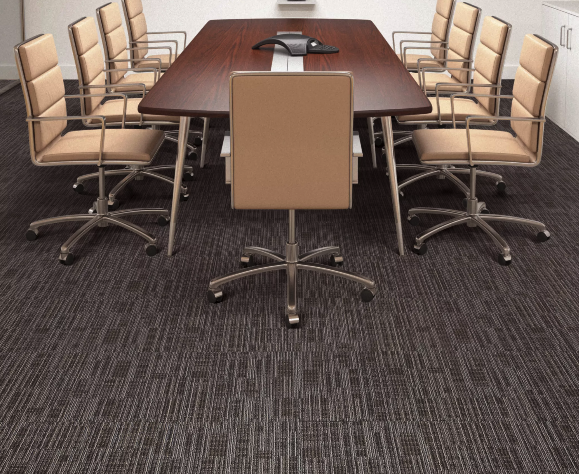
Somewhere between the plush comfort of wall-to-wall carpet and the wipe-clean practicality of hard flooring sits a category most Atlanta homeowners have walked across a thousand times without ever considering for their own house: carpet tile. Those square modules underfoot in offices, schools, and airports are not just a commercial convenience — they are one of the smartest answers we stock for finished basements, playrooms, home offices, and yes, the workspaces of North Fulton’s businesses, which our commercial installation team serves alongside our residential work.
The pitch is structural, not stylistic: carpet softness, delivered in pieces you can plan, mix, replace, and lift one square at a time. This guide covers what the modular format genuinely does better than traditional broadloom, the installation patterns that completely change its look from the same box of tiles, the household disasters it absorbs gracefully where other floors hold grudges, and how to spec it like a seasoned facilities manager even if your “facility” is a basement rec room in Johns Creek. The current lineup — about four dozen styles at this writing — lives in our carpet tile catalog, with free samples shipped straight to your door.
What Carpet Tile Actually Is (and Is Not)
Carpet tile — also called modular carpet — is carpet manufactured as discrete squares with an engineered, dimensionally stable backing built into each piece. No separate pad, no wall-to-wall stretching, no seaming irons: tiles install edge to edge over a properly prepared floor, usually with releasable adhesive or adhesive dots, which is precisely what makes individual squares liftable later. The backing is the quiet hero — it gives each tile its stability, its moisture tolerance, and its ability to sit flat for years while still surrendering peacefully when you want one square up.
What it is not: the flimsy peel-and-stick squares of decades past. Modern modular carpet is a commercial-grade engineering category — dense low pile, solution-dyed fibers in many lines, backings designed for real service. It is also not broadloom’s twin in feel: most carpet tile runs lower and firmer than plush wall-to-wall, closer to a sport coat than a duvet. That trade — a little plushness for a lot of control — is the whole decision, and the tools below make it concrete.
One Box of Tiles, Four Different Floors: The Pattern Mixer
Here is the design secret of modular carpet: the installation pattern is part of the product. Because every tile has a pile direction (carpet’s nap catches light differently at different angles), the same square laid four ways produces four visibly different floors — from a seamless broadloom impression to a deliberate checkerboard. The little dot on each tile below marks its corner; watch the directions:
Monolithic: every tile points the same way, and from standing height the floor reads almost like broadloom — the seams nearly disappear. The formal, seamless choice; it also asks the most of dye-lot consistency, which is why ordering all tiles together (plus spares) matters.
The Five Disasters: An Honest Ledger
Every flooring category should be judged in its worst week, not its first. Below are five very real things that happen to floors in family basements and busy offices alike. Open each incident and compare how the two carpet formats absorb it — the running hassle tally at the bottom keeps score.
The honest footnote: broadloom still wins on plush, seamless luxury — bedrooms and formal living rooms remain its kingdom, and our carpet catalog is deep for exactly those rooms. The ledger is about hard-service spaces, where modularity changes the math.
Spec It Like a Facilities Manager: The Switchboard
Commercial buyers spec carpet tile with a requirements checklist; homeowners can borrow the discipline. Flip the switches that describe your space — each one lights up the corresponding line of your build sheet:
Your build sheet (0 specs engaged)
- Flip switches above to assemble your spec.
- Dense low-loop construction with a chair-rated backing — rolling casters demand commercial-grade face and base.
- Moisture-tolerant backing and releasable adhesive — tiles that lift, dry, and relay turn basement scares into chores.
- Modular carpet’s soft face is the acoustic fix — spec cushion-back styles where sound matters most.
- Mixed-color layouts from one product family — borders, zones, and inset “rugs” planned at design time cost little and read custom.
- Order attic stock — spare tiles from your dye lot — and choose quarter-turn or random patterns so future changes blend invisibly.
The Anatomy of a Square
Pick up a carpet tile and you are holding a small engineering sandwich. The face fiber on top — usually nylon in commercial-grade lines — does the showing and the wearing; many modern tiles use solution-dyed fiber, meaning the color runs through the strand like a carrot rather than coating it like a radish, which is why bleach-based cleaners and brutal sunlight that would ghost ordinary carpet leave these unbothered. Beneath the face sits the engineered backing system — the dimensional skeleton that keeps each square flat for a decade, shrugs off moisture, and releases cleanly when lifted. Cushion-backed variants add a comfort layer that closes the gap with broadloom underfoot while improving acoustics another notch.
Why the anatomy lesson matters: when you compare two tiles at different prices, the differences live in exactly these layers — fiber type and density above, backing quality below. It is the same five-minute literacy that separates commercial buyers from catalog browsers, and our showroom team will gladly flip samples upside down with you; the backs of carpet tiles are honestly more informative than the fronts.
Designing with Squares: Borders, Zones, and Inset Rugs
Modularity is not just maintenance insurance — it is a design medium. Because every square is independent, mixed layouts cost little more than single-color ones: a contrasting border tracing the room’s edge, a zone of warmer color defining the play area within a larger field, an inset “rug” of patterned tile framed by solid tile under the basement seating group. Commercial designers have used these moves for decades to mark wayfinding and brand moments; at home the same vocabulary turns a rectangular basement into rooms-within-a-room without a single wall.
The discipline that keeps it elegant: stay inside one product family so heights and backings match seamlessly, and sketch the layout before ordering so the border math comes out even. Both are exactly the kind of details a design-consultation-plus-measure visit resolves in an afternoon — and both photos beautifully in the kind of project our inspiration gallery exists to collect.
The Atlanta Basement Question, Asked Properly
Since basements are modular carpet’s biggest residential stage here, let us ask the real question: what about moisture? The honest framework has three layers. First, the slab itself: concrete below grade breathes vapor, and any soft floor over it deserves a moisture evaluation before installation — that is part of our estimate, not an upsell. Second, the product: carpet tile’s engineered backings and pad-free construction make it the most moisture-sensible soft surface for below grade — nothing underneath to soak, squares that lift for drying. Third, the history: a basement with past water events needs its cause addressed at the building level; flooring is the beneficiary of that fix, never the substitute for it.
Inside that framework, the pairing logic writes itself: carpet tile across the rec room and play zones for warmth and acoustics, with waterproof luxury vinyl at the walkout door, the bar corner, and the bathroom — soft where you sprawl, waterproof where water plausibly arrives. That two-material basement is one of the most-requested layouts we install in North Fulton, and the transition details between the two are standard scope.
The Commercial Playbook, Briefly
For the offices, studios, suites, and storefronts our commercial team serves, carpet tile is less a product choice than an operating strategy. Installation phases around business hours — a section per evening, furniture shuffled zone by zone rather than moved out. Attic stock turns year-three coffee incidents into five-minute fixes instead of facilities tickets. Re-zoning — new desk pods, a bigger conference room — reuses the same floor instead of replacing it. And the acoustic case writes itself in any open plan. If you manage a space anywhere in the North Fulton area, the same free walkthrough that starts our residential projects starts commercial ones, with job supervision and coordination on the services list because commercial schedules are part of the product.
Where Modular Carpet Wins in North Fulton Homes
Finished basements lead the list, and Atlanta is a basement market — unlike much of the Sun Belt, our housing stock digs in. Below grade, the moisture honesty of modular carpet (liftable squares, no drowned pad) plus its warmth underfoot makes it the category to beat for rec rooms and home gyms. Playrooms come second: spill-proof in practice, zone-able in bright colors, soft enough for tumbling. Home offices — North Fulton’s fastest-growing room type — get the chair-friendly, acoustic, professional-on-camera floor that hard surfaces and plush broadloom both fumble. And basement stairs into rec rooms? That junction is a design conversation worth having in person; soft treads and modular fields can meet several ways.
For businesses — the offices, studios, and suites our commercial team serves across Alpharetta, Johns Creek, Roswell, and Milton — the same logic compounds: install around weekends, repair by the square, re-zone when the team grows, and keep attic stock so year-three repairs match. Job supervision and coordination is on our services menu precisely because commercial schedules are part of the product.
The Three-Way Context: Tile vs. Broadloom vs. Hard Surface
Carpet tile’s honest position sits between two neighbors. Against broadloom, it trades plush seamlessness for control: lower pile, visible grid (unless installed monolithic), but modular repair, moisture sense, and pattern play that wall-to-wall cannot match. Bedrooms and formal living rooms still belong to broadloom; basements, offices, and play zones increasingly do not. Against hard surface — the luxury vinyl and laminate that dominate main levels — carpet tile concedes wipe-clean invincibility but wins warmth, acoustics, and fall-friendliness, which is why the classic basement pairing puts plank at the wet edges and modular carpet across the living middle. The takeaway is not a winner; it is a map: each format owns territory, and the best North Fulton projects deploy all three where each is strongest — coordinated, ideally, in one design conversation rather than three separate purchases.
From Sample to Installed: The Timeline
Modular projects move quickly. Shortlist styles in the catalog and order free samples — checking them flat on your actual floor, under your actual lighting. Book the free estimate (next-day appointments available): measurements, slab or subfloor check, layout and pattern decisions, attic-stock math. Material arrives boxed and stacks neatly — no rolls wrestling through doorways — and installation itself is among the fastest in flooring: no stretching, no seams to iron, rooms typically back in service the same day. For commercial clients, that speed compounds with phasing; for households, it means the basement is a rec room again by the weekend.
Living With It: The Short Manual
Carpet tile’s care routine is carpet’s, minus the drama: regular vacuuming (grit is the enemy of every fiber), prompt spot response, and walk-off mats at exterior doors — in our region, those mats earn their keep during pollen season and red-clay springs more than any other weeks of the year. The modular bonus changes the failure mode: when a spot does win, the worst case is a square, not a room. Keep your spares flat in a closet, note your dye lot, and the floor effectively maintains itself into the next decade. For fiber-level guidance — what nylon and friends each do best — our carpet fiber overview covers the fundamentals that apply to modular and broadloom alike.
Carpet Tile Questions, Answered Straight
Does carpet tile feel cheap compared to regular carpet?
Can I really replace one tile years later and have it match?
Is carpet tile safe for a basement that has had moisture scares?
Do you handle commercial projects?
What does installation involve for a home?
How many spare tiles should I keep?
Can carpet tile go on stairs?
Where do I start?
The Floor That Plans Ahead
Step back and the pattern across this whole guide is one idea wearing different outfits: modularity converts permanent decisions into adjustable ones. The pattern you chose in the Mixer can be re-laid. The incident that would have condemned a broadloom room costs one square from the closet. The spec sheet you built on the Switchboard can evolve when the office grows or the kids graduate from the playroom. In a category where every other product asks for a crystal ball, carpet tile asks only for a plan — attic stock, a forgiving pattern, and an installer who set it up right. That is a fundamentally different relationship with a floor, and once households experience it in one room, the second modular room tends to follow.
Every other carpet decision asks you to predict a decade of family life and get it right the first time. Carpet tile is the format that forgives the prediction — swap the square, rotate the lane, re-zone the room, and keep going. For the basements, playrooms, offices, and businesses of North Fulton, that is not a compromise on carpet; it is carpet with a contingency plan. See what your neighbors say in our reviews, then bring us the room, its measurements, and its worst-case scenarios — we have a square for every one of them.
Modular comfort, planned like a pro — from one playroom to a whole office floor.
Request Your Free Estimate
